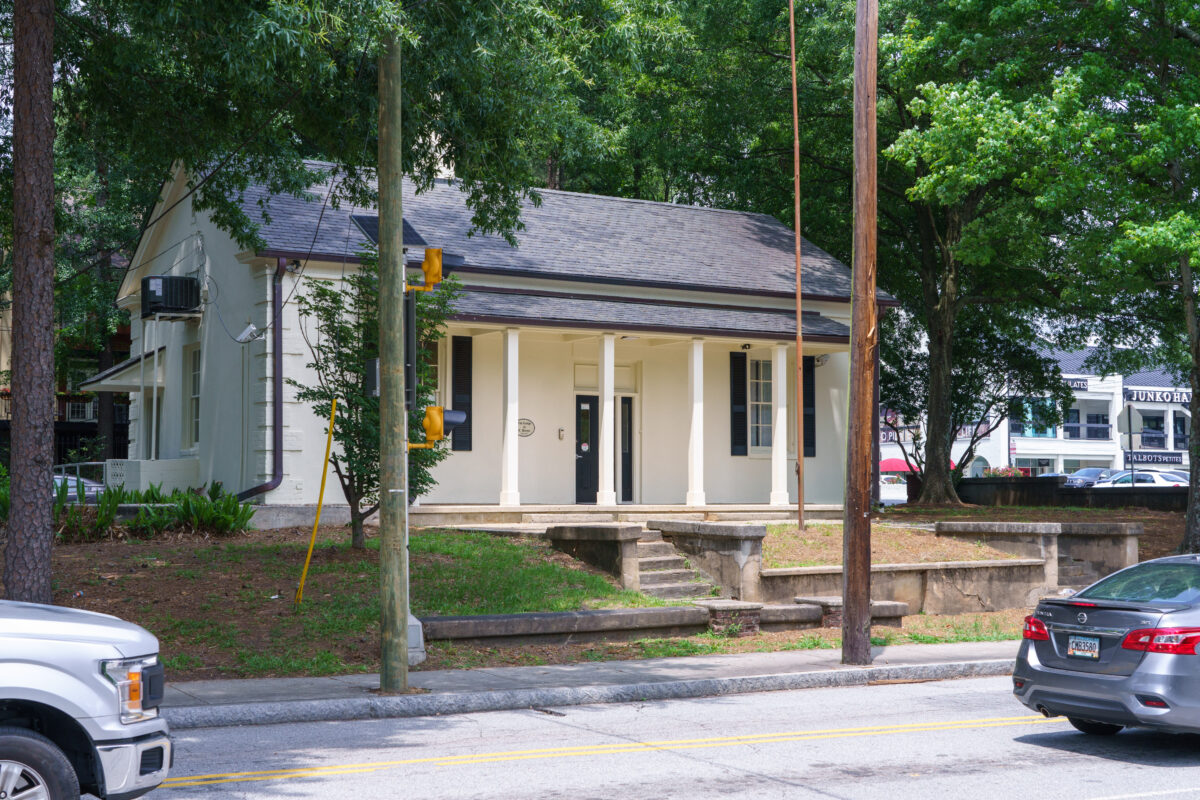
You have seen it a thousand times without ever quite seeing it. A small white building, almost cottage-like, marooned on a grassy island in the middle of Peachtree Battle Avenue, where it meets Peachtree Road, facing E. Rivers Elementary. Cars stream past it on both sides. Most people couldn’t tell you its name. Fewer still know that this modest structure is, arguably, where Buckhead’s modern era as a luxurious residential enclave began.
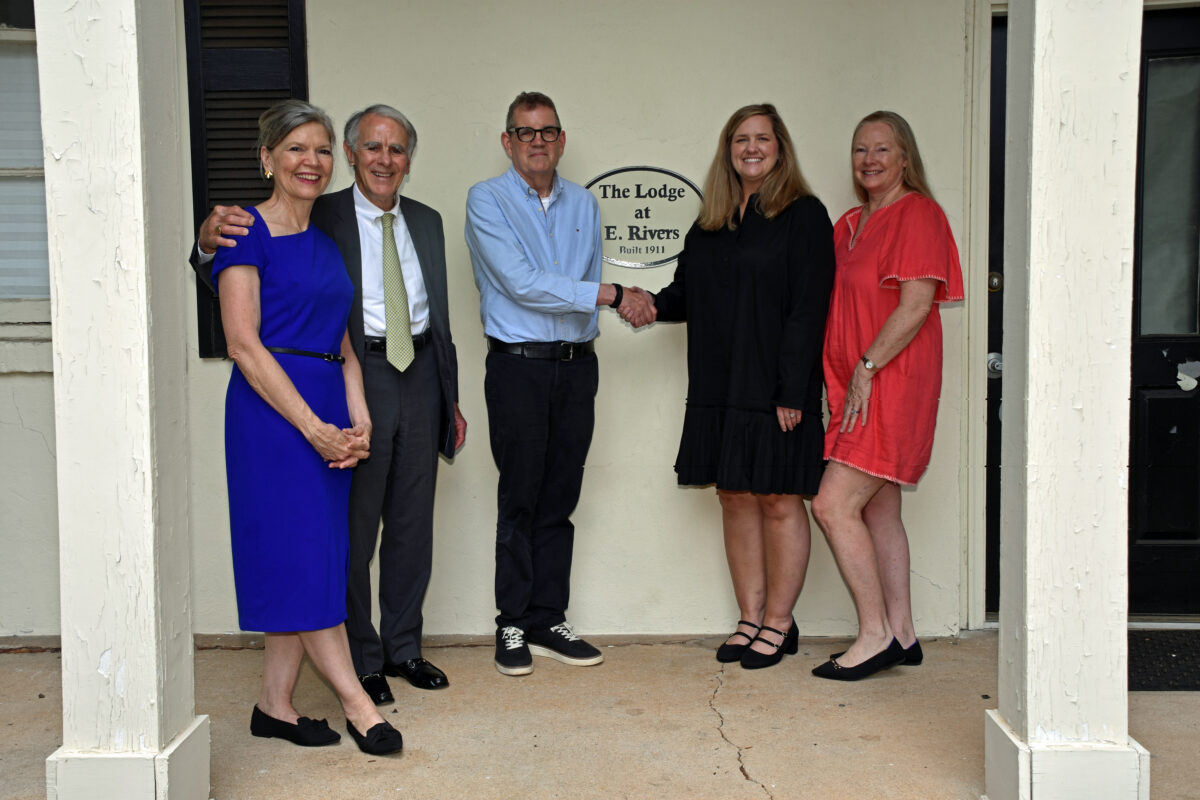
Now it is about to begin again. Buckhead Heritage signed a 5-year lease with Atlanta Public Schools (APS) to make the building — known across several generations as the Lodge at E. Rivers, Mrs. Bloodworth’s Kindergarten, and simply “the Little White House” — its new headquarters. Working in partnership with the Peachtree Battle Alliance, the nonprofit plans to invest close to $100,000 in restoring the building and its grounds, funded entirely through private support, with no taxpayer dollars. After a century of quiet service, the oldest real estate office in Buckhead is coming back to public life.
It is a fitting home for an organization devoted to Buckhead’s history.
From sales office to schoolhouse
To understand the Lodge, you have to meet the man who built it: Eretus “Petie” Rivers, who left the Central of Georgia Railway (since absorbed into Norfolk Southern, now headquartered just up the road) to become one of Buckhead’s first real estate agents — and, arguably, the closest thing the neighborhood has to a founding father of its modern self.
In 1906, Wesley Gray Collier — a farmer who owned hundreds of acres along Peachtree Road and was eulogized by the Atlanta Constitution as “another of those rugged pioneers who laid the foundation of the city’s greatness” — died and instructed his sons to subdivide and sell his estate. That decision set off the defining land rush in Buckhead’s history. In 1910, Rivers and his partner, attorney Walter P. Andrews, acquired 483 acres of the Collier property for $375,000. The Atlanta Constitution called it “the largest single real estate deal Atlanta has ever known”; the Atlanta Journal predicted it would have “the most far-reaching effect” on Peachtree Road’s possibilities. They were both right. On that land, Rivers laid out Peachtree Heights Park — known today as Peachtree Heights West and Haynes Manor — and Buckhead’s transformation from a country district of summer homes, hunting lodges, and farms into Atlanta’s premier residential district was underway.
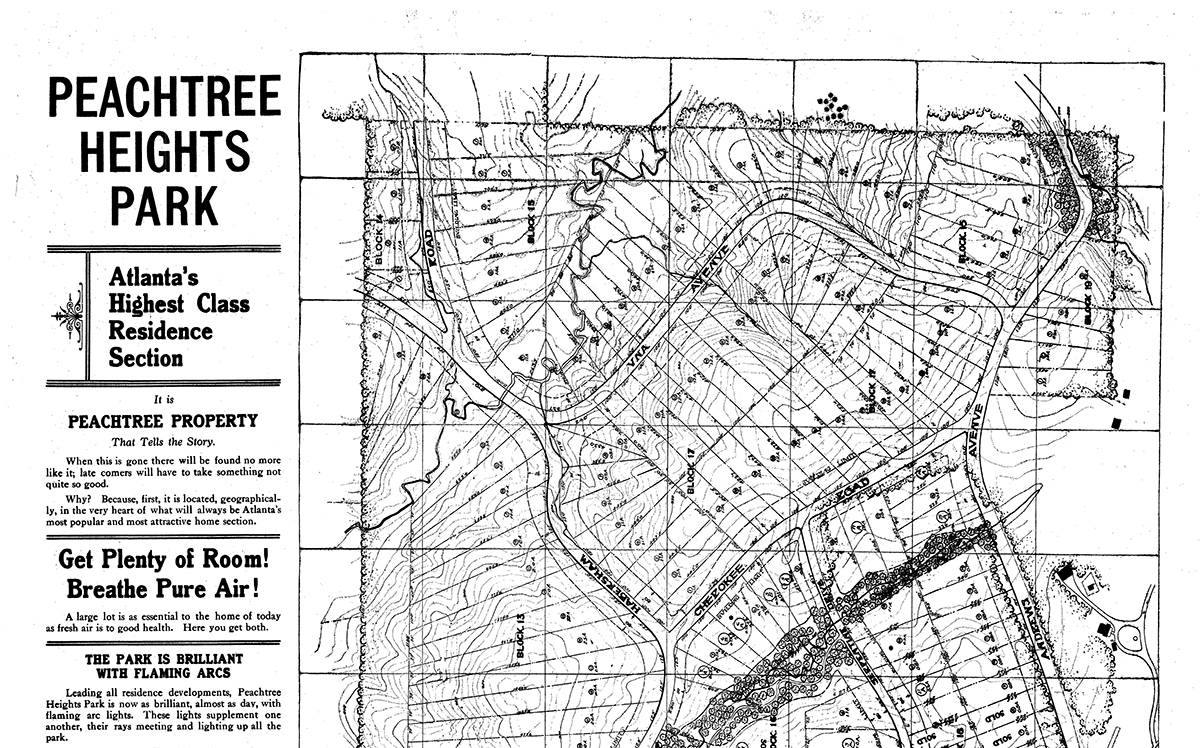
Rivers turned out to be a born salesman. A surviving plat and advertisement from his E. Rivers Realty Company, circa 1910–11, reads like a carnival barker’s pitch dressed in a frock coat. It promised “Pure Air! No City Taxes,” boasted of flaming arc streetlamps that lit the avenues “as brilliant, almost as day,” and assured prospective buyers that an improved trolley line would whisk businessmen downtown in “only 24 minutes.” (More than a century later, that drive still takes about 24 minutes — some things in Buckhead never change.)
To close those sales, Rivers needed an office. He built it on the little triangle of land at the gateway to his new neighborhood, where Peachtree Battle meets Peachtree Road — and there it has stood ever since. It is usually dated to 1911, the year stamped on the sign that hangs on it today, though preservation researchers place its construction closer to 1909. Either way, it predates almost everything around it. As Ivan Allen IV, who oversaw the agreement for Buckhead Heritage, put it: “This is one of the most historic buildings in Buckhead and the city of Atlanta. We don’t have many 115-year-old buildings.”
A world-class pedigree for a tiny building
Here is the detail that surprises even longtime residents: the unassuming Lodge carries one of the most distinguished architectural signatures in America.
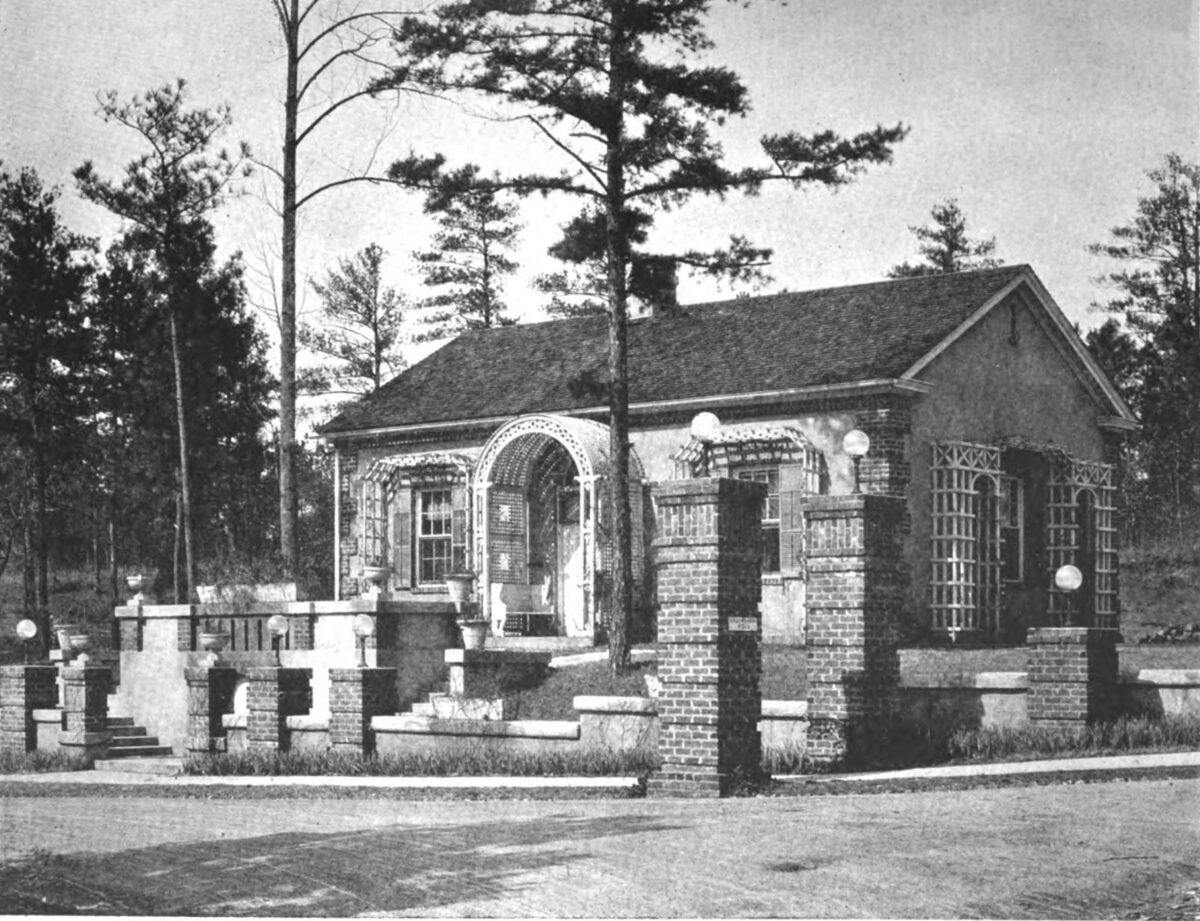
Rivers did not hire a local builder for his sales office. He commissioned Carrère & Hastings, the celebrated New York firm of John Merven Carrère and Thomas Hastings — the same architects responsible for the main branch of the New York Public Library, the Russell Senate Office Building in Washington, the Frick mansion, and the Standard Oil Building on lower Broadway. The firm designed the entire street plan of Peachtree Heights Park, its graceful curvilinear layout following the natural terrain, and the Lodge was the elegant punctuation mark at its entrance. Peachtree Heights Park is often described as the only residential neighborhood the firm ever designed.
The building was admired enough in its day to be featured in the September 10, 1913, issue of American Architect, the leading professional journal of the era — a remarkable distinction for what was, in essence, a real estate office with very good manners. The original photograph survives, courtesy of the Atlanta-Fulton County Public Library, and shows the core building much as it stands today, though the original arbors framing the door and windows have since given way to a columned porch. The pedigree carries a note of poignancy, too: John Carrère died in a 1911 streetcar accident at the height of his career, just as Rivers’ neighborhood was taking shape. The New York Times wrote of him, “As an architect, he had, probably, no superior in this country.”
A building of many lives
What makes the Lodge extraordinary is not just how it began, but how thoroughly it kept reinventing itself.
Its public chapter started early. In June 1911, a local chapter of the Daughters of the American Revolution took over the building and used it to host community events — the first of many ways the Lodge would belong to the neighborhood rather than to any one owner.
Its most beloved era began in 1930, when the Lodge became the home of Mrs. Bloodworth’s Kindergarten. Mary Hardwick Bloodworth had recently lost her husband, Herbert Rainer Bloodworth, a prominent figure at the Atlanta National Bank, and was adjusting to widowhood. A neighbor with five young boys — “too young for school and too much for her to handle” — asked Mrs. Bloodworth to take them in a spare room of a Druid Hills home. Word spread, the children multiplied, and Rivers offered her the Lodge in late 1929 — a move that Buckhead Heritage’s John Beach has suggested may have been hastened by the stock market crash only weeks earlier. There she stayed for the better part of two decades.
The picture that survives is irresistibly tender. The small yard served as both a playground and a cafeteria, with the children carrying their lunches from home; the school offered cookies, milk, hot chocolate, and the occasional lemonade. Mrs. Bloodworth taught music and staged little plays — a 1932 production of “Mother Goose’s Village” earned a mention on the society page. And because her kindergarten, though unaffiliated with the public schools, fed directly into the elementary across the street, she would walk her students across Peachtree Battle Avenue to tour E. Rivers Elementary so they would know what to expect in first grade. By the time she retired around 1950 — her obituary credited her with 30 years at the head of her school — she had guided a generation of Buckhead children through that door.
That elementary school is another piece of the Rivers legacy. He donated the land for it and served on the Atlanta Board of Education; the school opened in 1917 as Peachtree Heights School and was renamed in his honor in 1926.
In 1937, the Peachtree Heights Park Company deeded the Lodge to Fulton County for the symbolic sum of $1 — but with a condition that has shaped its fate ever since. The deed restricts the property to “museum, monumental, educational, park, or other like purpose,” and provides that it reverts to the grantor if those uses lapse. That restriction has followed the building through its transfer to the City of Atlanta and, in 2018, to Atlanta Public Schools. It is the reason the Lodge has never been demolished — and the reason its future has so often hung in the balance.
Where Buckhead’s battlefield meets its boulevard
The island the Lodge sits on tells its own story. Peachtree Battle Avenue takes its name from the Battle of Peachtree Creek, fought just steps away on July 20, 1864, when more than 7,000 Federal and Confederate soldiers fell in a pivotal clash of the campaign for Atlanta. In 1915, a fifty-foot strip was set aside both for park purposes and to commemorate the Peachtree Creek battles. A Civil War memorial erected in 1935 still stands in that median, about 250 feet west of the Lodge, in front of the school.
A constant, preserved
The Lodge’s most recent chapter could have ended badly. When APS quietly added the building to its “surplus” list a few years ago, Buckhead’s preservation community sounded the alarm. The district’s own historic inventory flagged the Lodge as one of its most significant buildings — while acknowledging the puzzle of how to reuse a tiny structure stranded on an outsized median. Preservationist Laura Dobson made the case that mattered most. “It’s literally where the neighborhoods of Peachtree Battle began,” she said. Small buildings like this one, she argued, are easy to take for granted in a world where bigger is better, yet they are essential to the depth of a community — and if they are saved and stay loved, they keep making memories.
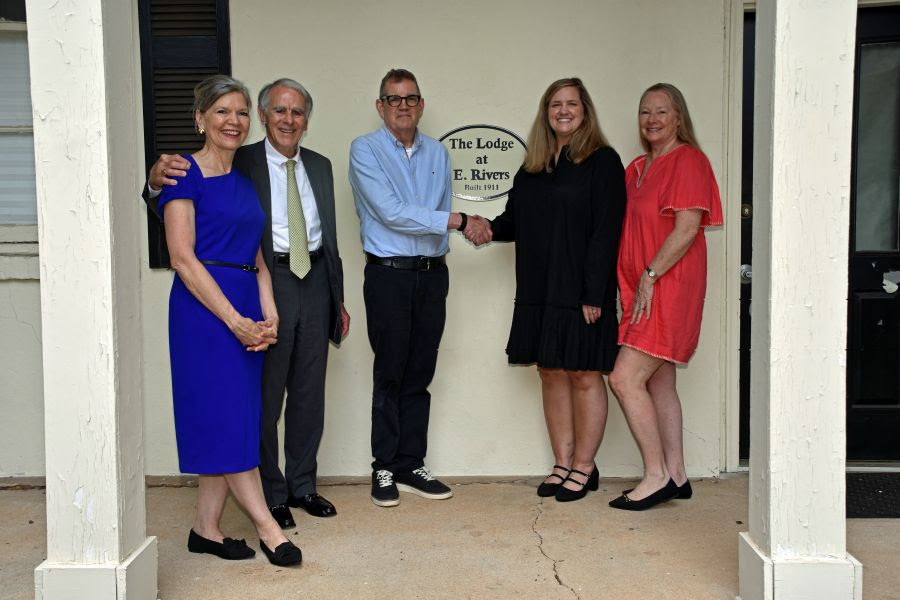
For Buckhead Heritage, the preservation nonprofit now celebrating its 20th year, saving the Lodge is both a milestone and a mission statement. Board secretary Frank Virgin framed it as a beginning rather than an end: Buckhead Heritage will “open this building up for the community, preserve and improve it, and create a space for residents and visitors to learn Buckhead’s history.” He called it “exactly the kind of project Buckhead Heritage was created to champion … a resource for the entire community,” and — invoking the milestone year — “a catalyst for broader engagement, preservation, and growth for the next 20 years and beyond.” Buckhead Heritage invites residents and businesses to help fund the restoration through memberships, sponsorships, and tax-deductible gifts; details are available at buckheadheritage.com.
There is a quiet comfort in familiar things — the landmarks that are reliably there. The little white house has been many things, but its steadiest gift has always been the same: it stays. In a part of town that never stops remaking itself, it remains the constant on the corner — and that is the comfort it gives Buckhead.