
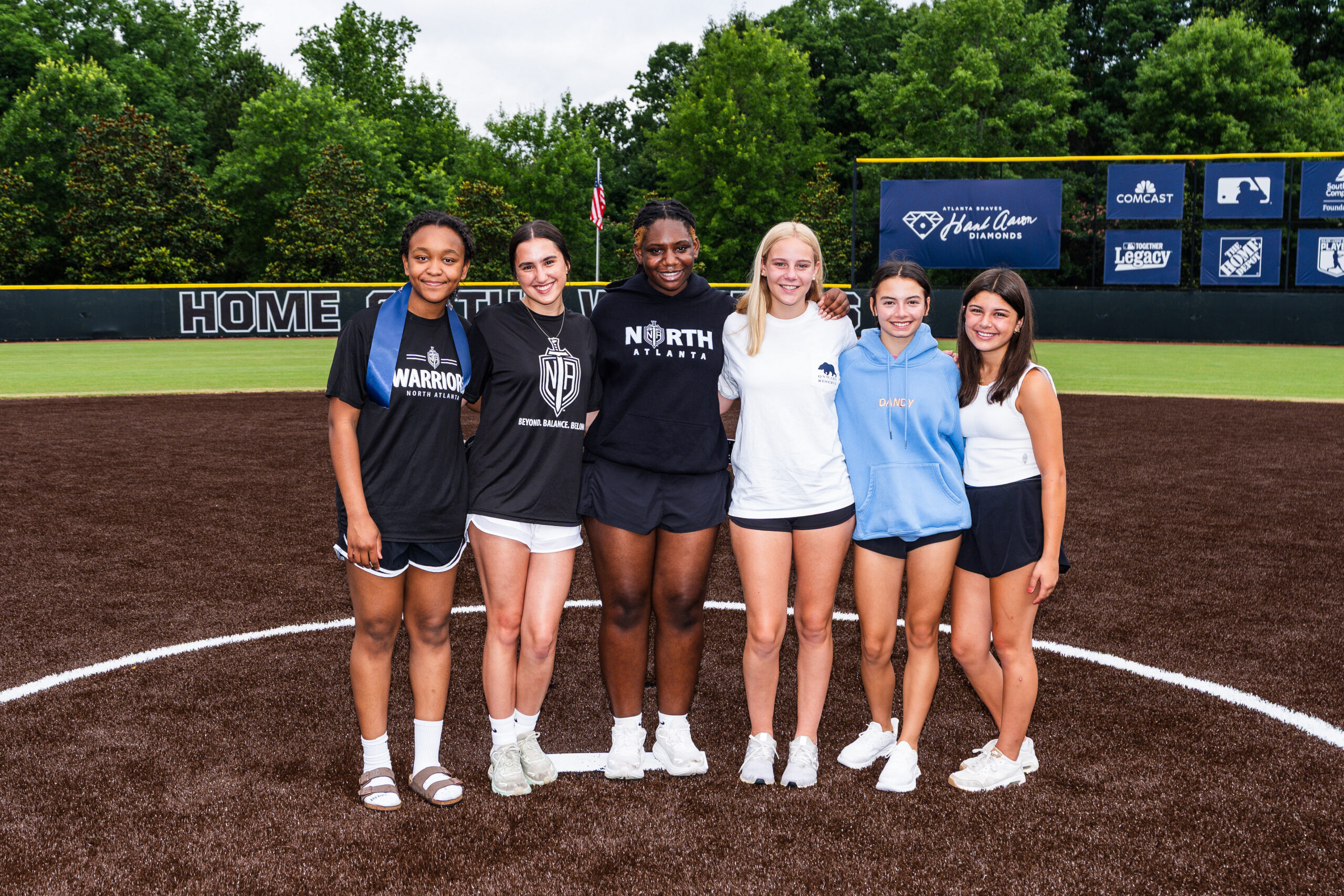
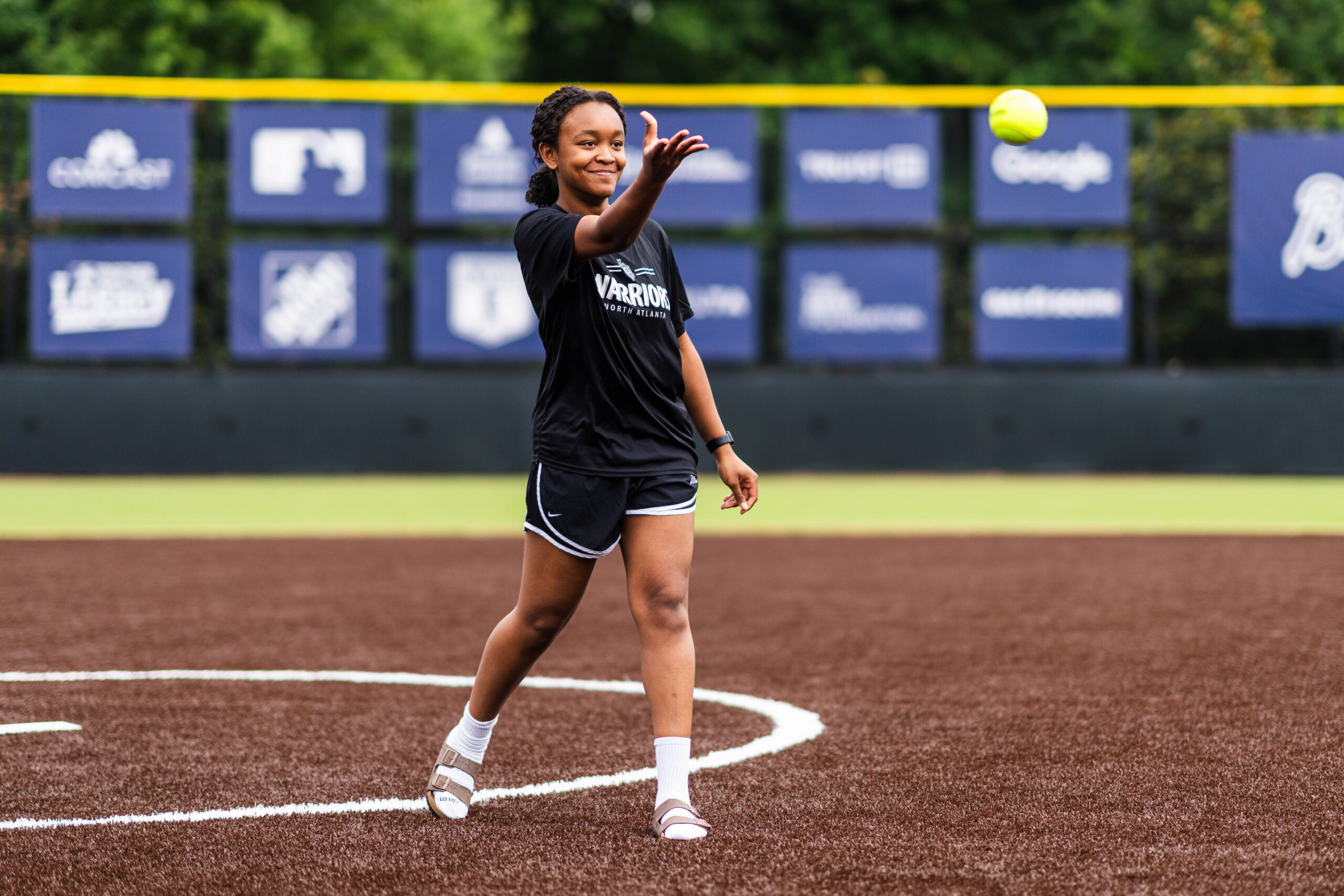
As part of its Hank Aaron Diamonds initiative, funded through the Atlanta Braves Foundation’s Henry Louis Aaron Fund, the Atlanta Braves unveiled three new softball fields across Atlanta, including one at Buckhead’s North Atlanta High School, 4111 Northside Parkway NW. The North Atlanta Warriors held a ribbon-cutting for their field on June 17.
Each project includes a new turf infield and other needed facility upgrades designed to create a consistent, durable, and high-quality experience for student-athletes while opening the door for broader use by community-based programs. Truist Park, the Braves’ home ballpark, sits just northwest of Buckhead across the Chattahoochee in Cobb County, putting the team’s investment close to home for North Atlanta.
The North Atlanta field is one piece of a far larger commitment. Through the Hank Aaron Diamonds initiative, the Braves are rebuilding and upgrading the infields at every operating high school in the Atlanta Public Schools (APS) district — a project that furthers Hank and Billye Aaron’s legacy of supporting youth through sport and education. Costs are covered through the Atlanta Braves Foundation’s Henry Louis Aaron Fund, which backs efforts to increase representation in the game at all levels, showcase young talent from underrepresented communities, and create educational and career development opportunities for future minority business leaders.
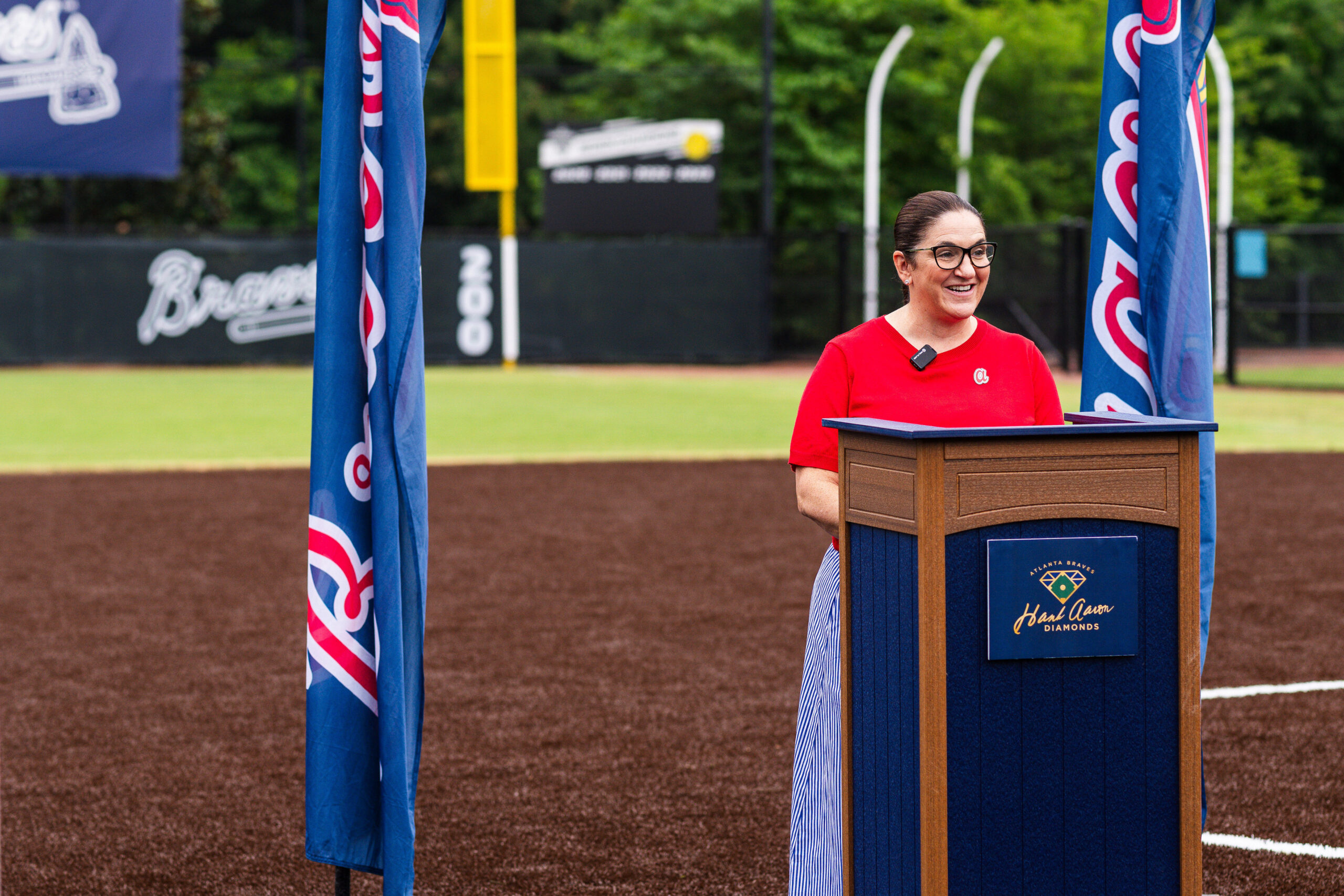
For Braves President & CEO Derek Schiller, the initiative is as much about the man it honors as the game itself. “Hank Aaron was one of the greatest players this game has ever seen, but he was an even better person,” Schiller said. “Off the field, he and Billye devoted so much of their time and effort to supporting the educational pursuits of young people. The Atlanta Braves, through the Henry Louis Aaron Fund, are proud and humbled to further this legacy of service with the Hank Aaron Diamonds, in partnership with Atlanta Public Schools. We know that these fields will enable future generations to chase their dreams, on and off the diamond, just like Hank did.”
Beyond the turf infields and facility upgrades, the diamonds are designed to expand access well past varsity rosters, opening opportunities for middle school and community-based baseball and softball programs and supporting the growth of Braves RBI (Reviving Baseball in Inner Cities), a youth development program powered by the Marquis Grissom Youth Baseball Association.
District leaders described the gift as a turning point for APS athletics. “We are extremely appreciative of this generous gift and the support of the Atlanta Braves Foundation,” said APS Superintendent Dr. Bryan Johnson. “This partnership will be transformational for our baseball and softball student-athletes, as well as the schools and athletic programs that support them. I am also grateful for the leadership of our District Athletic Director, Greg Goodwin, and our entire athletics department. We are thankful that the Atlanta Braves Foundation believes so strongly in our student-athletes and in Atlanta’s public schools. This investment will have an impact on our schools for years to come.”
That sentiment was echoed by the district’s board, which framed the partnership as part of a broader, community-wide push for student success. “The Atlanta Board of Education is grateful to the Atlanta Braves and the Henry Louis Aaron Fund for their partnership and investment in our students,” said Erika Y. Mitchell, Chair of the Atlanta Board of Education. “Their support enhances the student experience across our district and reflects the community-wide commitment that Dr. Johnson continues to champion, ensuring every student has the opportunity to succeed both in the classroom and on the field.”
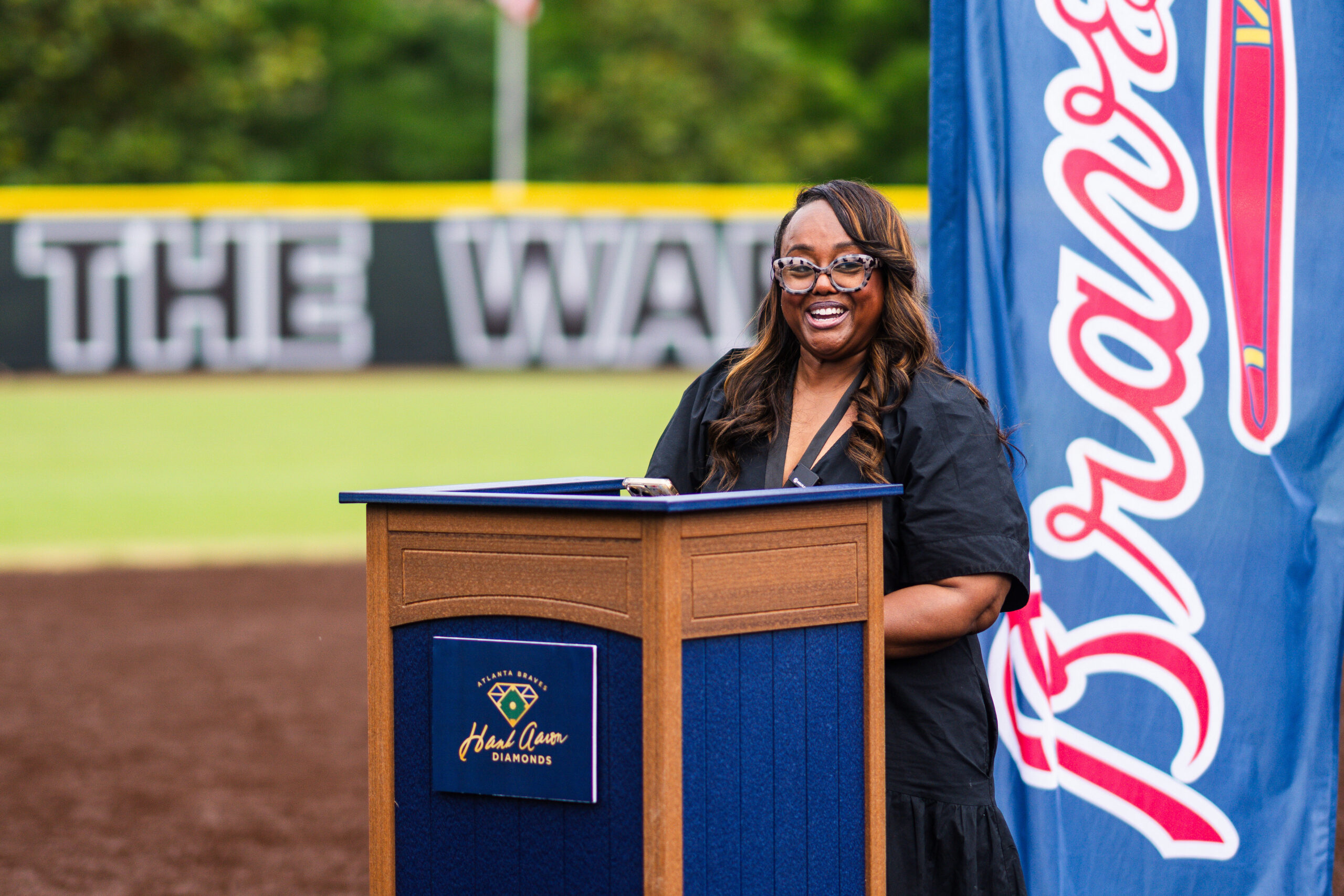
The fields also carry a practical benefit for the district, lowering the cost of upkeep even as they widen access — a point Danielle Bedasse, the Braves’ Vice President of Community Affairs and Atlanta Braves Foundation Executive Director, tied directly to the donors who made the work possible. “Youth sports empower athletes, teaching invaluable lessons about dedication, hard work, and teamwork, as well as increasing engagement and graduation rates,” Bedasse said. “These beautiful Hank Aaron Diamonds will create opportunities for more students to train and compete for their local school and more opportunities for community-based sports, while reducing maintenance costs for APS. We are grateful to our corporate partners and community philanthropists whose generosity made it possible to create this beautiful legacy in Hank’s name and positively impact the lives of youth across the City of Atlanta.”
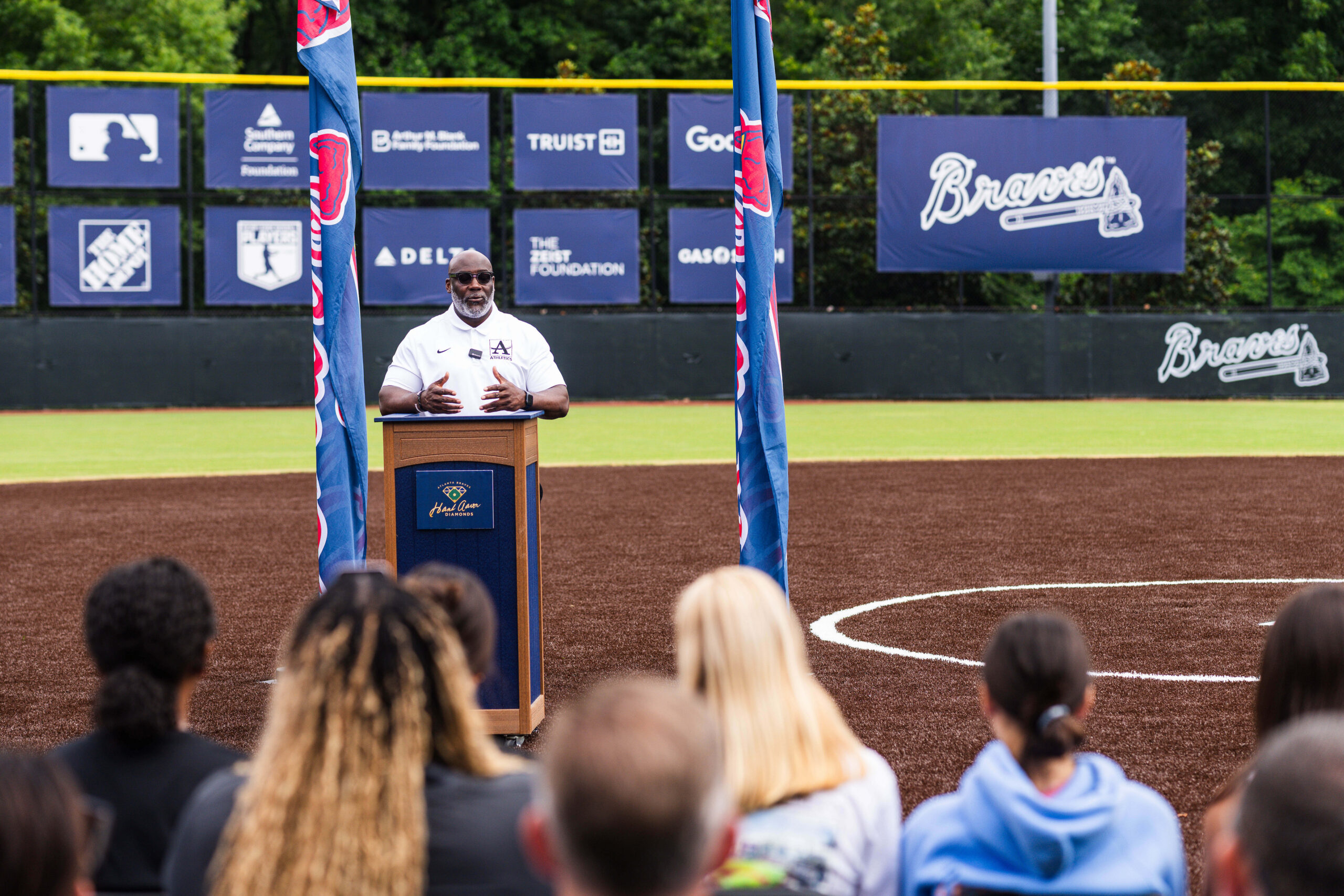
For the coaches and athletes who will use the diamonds day to day, the upgrades solve problems that have long shaped their seasons. “This incredible donation from the Atlanta Braves Foundation will be a game changer for the baseball and softball communities in the Atlanta Public School district,” said Greg Goodwin, Executive Athletic Director for Atlanta Public Schools. “For the project to have the name of one of the most iconic figures in baseball history, The Hank Aaron Diamonds, makes this even more meaningful to our district. These fields will eliminate most practice and game rainouts, as well as all infield maintenance. The opportunities are endless with these new playing surfaces.”
Rayonier, a major timberland real estate investment trust, has signed a lease for its new corporate headquarters in the heart of Buckhead — the first physical step in anchoring a newly merged timber giant in Atlanta following the close of its all-stock “merger of equals” with Washington State PotlatchDeltic on Jan. 30, 2026.
The now-combined company owns 4.2 million acres of timberland across 11 states — 3.2 million of them in the U.S. South and roughly 931,000 in the Pacific Northwest, concentrated in Idaho, Washington and Oregon. It also operates six sawmills and an industrial-grade plywood mill, making it one of the largest publicly traded timber and wood-products companies in North America, with a pro forma equity market capitalization of about $7.1 billion and an enterprise value near $8.2 billion.
The relocation caps a sweeping financial deal. Announced in October 2025 and finalized after market close on Jan. 30, the merger combined Florida-based Rayonier with Washington-based PotlatchDeltic, with PotlatchDeltic shareholders receiving 1.7339 Rayonier shares for each share they held — an implied $44.11 per share. Executives are targeting roughly $40 million in annual run-rate cost synergies within two years.
“Our new headquarters establishes a strategic hub in the heart of the U.S. South, combining a thriving business ecosystem with proximity to a significant portion of our landholdings,” said Mark McHugh, president and CEO of Rayonier. “Locating our headquarters in Atlanta builds on the combined company’s deep roots in Georgia, where we are the state’s largest private landowner, with nearly 850,000 acres of timberland.”

The merger made Rayonier the largest private landowner in Georgia, centralizing management of those nearly 900,000 acres at a fraught moment for the state’s forestry sector. The industry sustains well over 180,000 jobs statewide and was recently rattled by International Paper’s closure of its Savannah-area operations; Rayonier itself reported fire damage across roughly 10,000 acres, primarily in Georgia, in early 2026. Beyond logging, the company operates as a sophisticated REIT, managing master-planned developments such as the 24,000-acre Wildlight project near Jacksonville and pursuing land-based opportunities that include some 80,000 acres under option for utility-scale solar.
The company signed for roughly 36,000 square feet of Class A office space — about one and a half floors — in Terminus 100, the 27-story, 590,000-square-foot mixed-use tower owned by Cousins Properties at 3280 Peachtree Road. Occupancy is targeted for the first quarter of 2027. The space sits within a seven-minute walk of the Buckhead MARTA station (Red Line), with quick access to Georgia 400 and the retail at Lenox Square and Phipps Plaza. Ryanne Pennington and Brennan Koslow of JLL represented Rayonier, while Jeff Dils and Cameron Bloodworth represented Cousins Properties; JLL is managing the interior build-out, with design by ASD|SKY and general contracting by rand* construction. The company has said it will keep significant offices in Wildlight, Florida, and Spokane, Washington.
“Rayonier’s growing footprint in Georgia is a testament to their longstanding commitment to our state,” said Georgia Gov. Brian P. Kemp. “Our strategic location and resilient timber industry, combined with our pro-jobs approach, give us unmatched advantages for companies like Rayonier to serve their customers and experience long-term success here.”
Rayonier’s arrival lands as a marquee win for a Buckhead office market still working to prove its resilience against hybrid-work headwinds. The deal arrived alongside other notable district activity, including a 44,000-square-foot lease by luxury fitness brand Equinox at Buckhead Village — its first Georgia location.
The recruitment of a $7.1 billion public company offers arrives just as Katharine Kelley succeeds longtime leader Jim Durrett atop the Coalition and the Buckhead Community Improvement District.
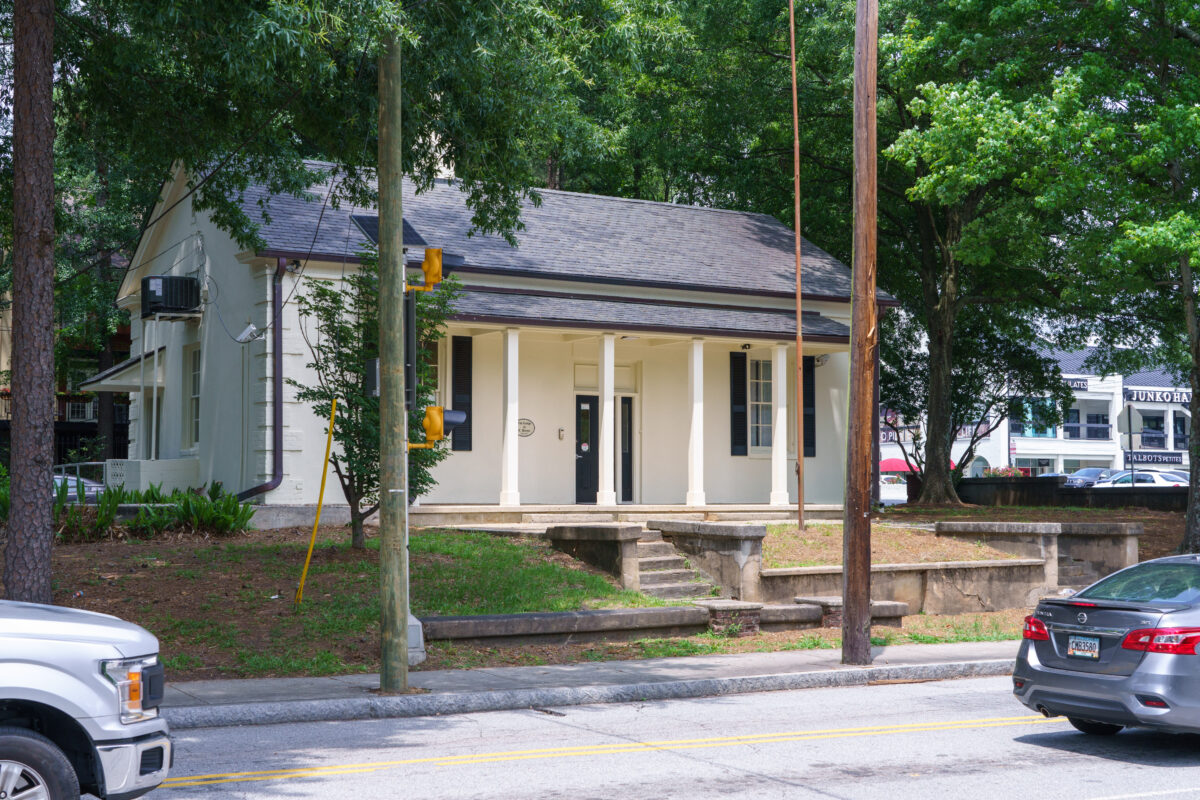
You have seen it a thousand times without ever quite seeing it. A small white building, almost cottage-like, marooned on a grassy island in the middle of Peachtree Battle Avenue, where it meets Peachtree Road, facing E. Rivers Elementary. Cars stream past it on both sides. Most people couldn’t tell you its name. Fewer still know that this modest structure is, arguably, where Buckhead’s modern era as a luxurious residential enclave began.
Now it is about to begin again. Buckhead Heritage signed a 5-year lease with Atlanta Public Schools (APS) to make the building — known across several generations as the Lodge at E. Rivers, Mrs. Bloodworth’s Kindergarten, and simply “the Little White House” — its new headquarters. Working in partnership with the Peachtree Battle Alliance, the nonprofit plans to invest close to $100,000 in restoring the building and its grounds, funded entirely through private support, with no taxpayer dollars. After a century of quiet service, the oldest real estate office in Buckhead is coming back to public life.
It is a fitting home for an organization devoted to Buckhead’s history.
To understand the Lodge, you have to meet the man who built it: Eretus “Petie” Rivers, who left the Central of Georgia Railway (since absorbed into Norfolk Southern, now headquartered just up the road) to become one of Buckhead’s first real estate agents — and, arguably, the closest thing the neighborhood has to a founding father of its modern self.
In 1906, Wesley Gray Collier — a farmer who owned hundreds of acres along Peachtree Road and was eulogized by the Atlanta Constitution as “another of those rugged pioneers who laid the foundation of the city’s greatness” — died and instructed his sons to subdivide and sell his estate. That decision set off the defining land rush in Buckhead’s history. In 1910, Rivers and his partner, attorney Walter P. Andrews, acquired 483 acres of the Collier property for $375,000. The Atlanta Constitution called it “the largest single real estate deal Atlanta has ever known”; the Atlanta Journal predicted it would have “the most far-reaching effect” on Peachtree Road’s possibilities. They were both right. On that land, Rivers laid out Peachtree Heights Park — known today as Peachtree Heights West and Haynes Manor — and Buckhead’s transformation from a country district of summer homes, hunting lodges, and farms into Atlanta’s premier residential district was underway.
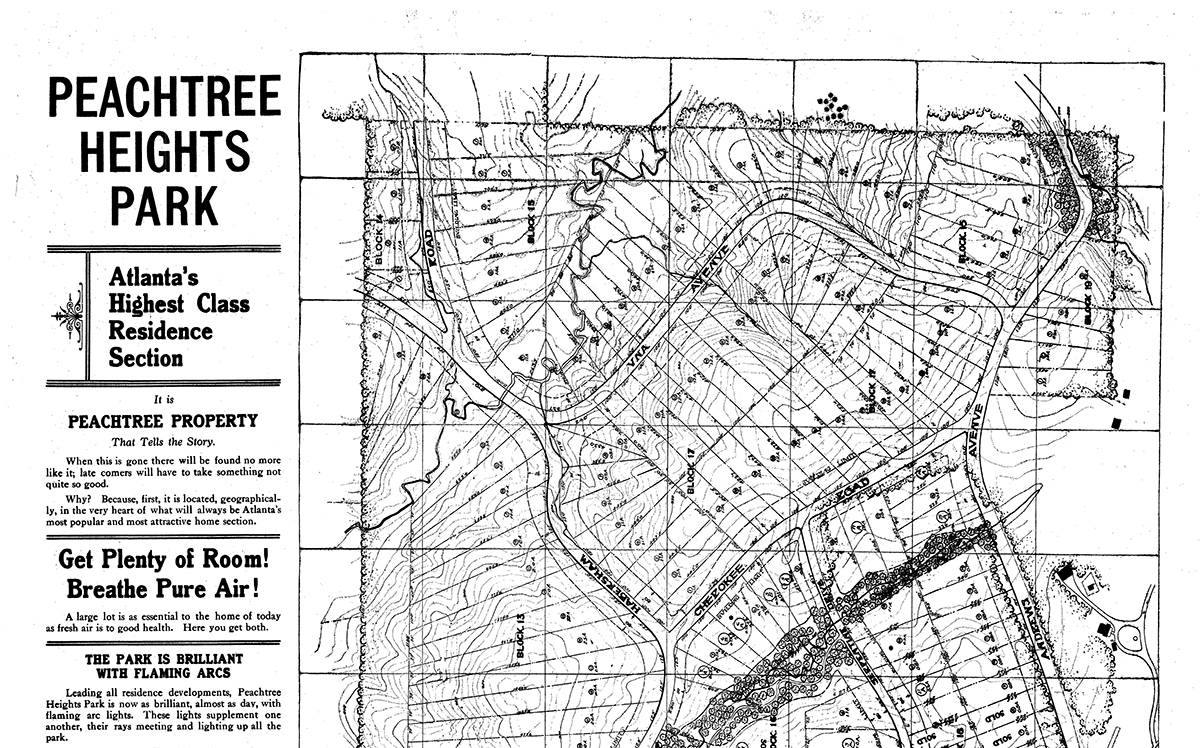
Rivers turned out to be a born salesman. A surviving plat and advertisement from his E. Rivers Realty Company, circa 1910–11, reads like a carnival barker’s pitch dressed in a frock coat. It promised “Pure Air! No City Taxes,” boasted of flaming arc streetlamps that lit the avenues “as brilliant, almost as day,” and assured prospective buyers that an improved trolley line would whisk businessmen downtown in “only 24 minutes.” (More than a century later, that drive still takes about 24 minutes — some things in Buckhead never change.)
To close those sales, Rivers needed an office. He built it on the little triangle of land at the gateway to his new neighborhood, where Peachtree Battle meets Peachtree Road — and there it has stood ever since. It is usually dated to 1911, the year stamped on the sign that hangs on it today, though preservation researchers place its construction closer to 1909. Either way, it predates almost everything around it. As Ivan Allen IV, who oversaw the agreement for Buckhead Heritage, put it: “This is one of the most historic buildings in Buckhead and the city of Atlanta. We don’t have many 115-year-old buildings.”
Here is the detail that surprises even longtime residents: the unassuming Lodge carries one of the most distinguished architectural signatures in America.
Rivers did not hire a local builder for his sales office. He commissioned Carrère & Hastings, the celebrated New York firm of John Merven Carrère and Thomas Hastings — the same architects responsible for the main branch of the New York Public Library, the Russell Senate Office Building in Washington, the Frick mansion, and the Standard Oil Building on lower Broadway. The firm designed the entire street plan of Peachtree Heights Park, its graceful curvilinear layout following the natural terrain, and the Lodge was the elegant punctuation mark at its entrance. Peachtree Heights Park is often described as the only residential neighborhood the firm ever designed.
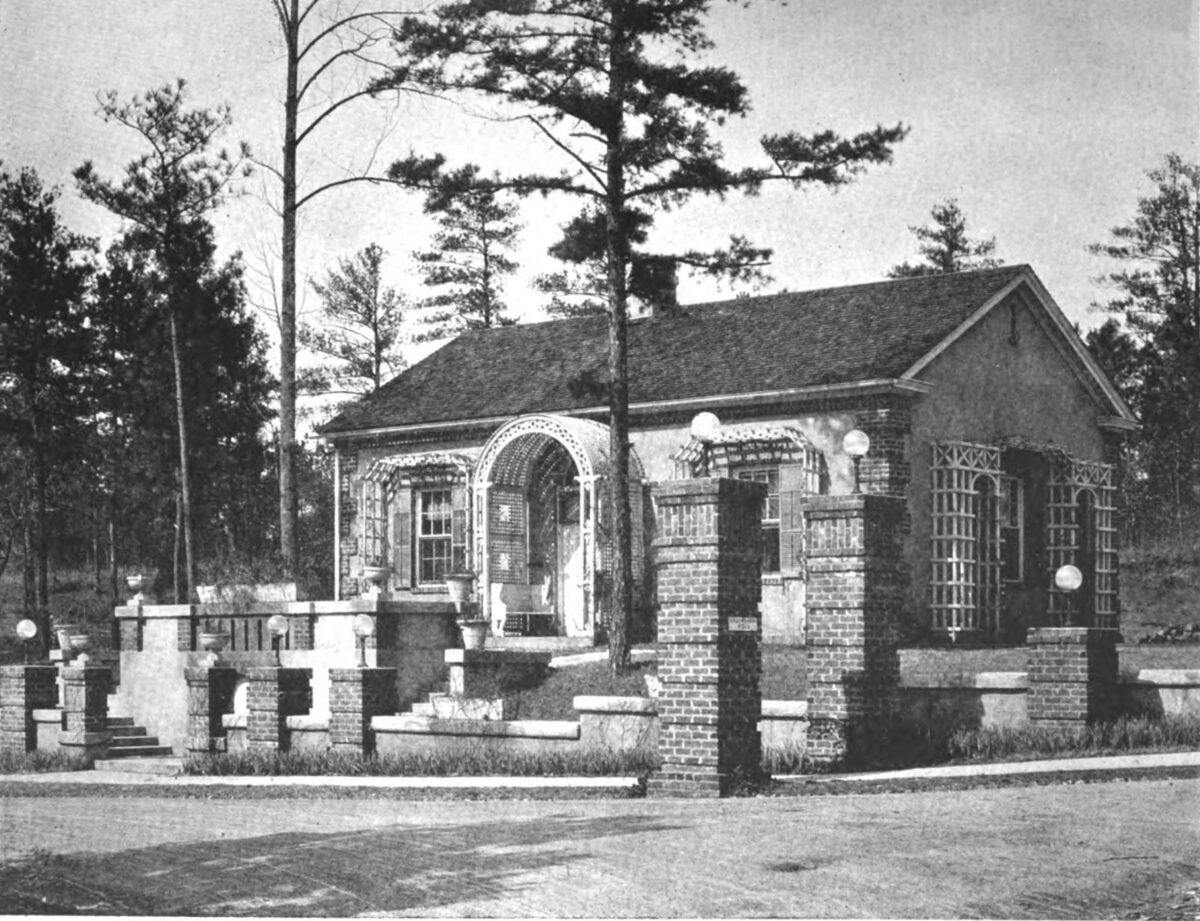
The building was admired enough in its day to be featured in the September 10, 1913, issue of American Architect, the leading professional journal of the era — a remarkable distinction for what was, in essence, a real estate office with very good manners. The original photograph survives, courtesy of the Atlanta-Fulton County Public Library, and shows the core building much as it stands today, though the original arbors framing the door and windows have since given way to a columned porch. The pedigree carries a note of poignancy, too: John Carrère died in a 1911 streetcar accident at the height of his career, just as Rivers’ neighborhood was taking shape. The New York Times wrote of him, “As an architect, he had, probably, no superior in this country.”
What makes the Lodge extraordinary is not just how it began, but how thoroughly it kept reinventing itself.
Its public chapter started early. In June 1911, a local chapter of the Daughters of the American Revolution took over the building and used it to host community events — the first of many ways the Lodge would belong to the neighborhood rather than to any one owner.
Its most beloved era began in 1930, when the Lodge became the home of Mrs. Bloodworth’s Kindergarten. Mary Hardwick Bloodworth had recently lost her husband, Herbert Rainer Bloodworth, a prominent figure at the Atlanta National Bank, and was adjusting to widowhood. A neighbor with five young boys — “too young for school and too much for her to handle” — asked Mrs. Bloodworth to take them in a spare room of a Druid Hills home. Word spread, the children multiplied, and Rivers offered her the Lodge in late 1929 — a move that Buckhead Heritage’s John Beach has suggested may have been hastened by the stock market crash only weeks earlier. There she stayed for the better part of two decades.
The picture that survives is irresistibly tender. The small yard served as both a playground and a cafeteria, with the children carrying their lunches from home; the school offered cookies, milk, hot chocolate, and the occasional lemonade. Mrs. Bloodworth taught music and staged little plays — a 1932 production of “Mother Goose’s Village” earned a mention on the society page. And because her kindergarten, though unaffiliated with the public schools, fed directly into the elementary across the street, she would walk her students across Peachtree Battle Avenue to tour E. Rivers Elementary so they would know what to expect in first grade. By the time she retired around 1950 — her obituary credited her with 30 years at the head of her school — she had guided a generation of Buckhead children through that door.
That elementary school is another piece of the Rivers legacy. He donated the land for it and served on the Atlanta Board of Education; the school opened in 1917 as Peachtree Heights School and was renamed in his honor in 1926.
In 1937, the Peachtree Heights Park Company deeded the Lodge to Fulton County for the symbolic sum of $1 — but with a condition that has shaped its fate ever since. The deed restricts the property to “museum, monumental, educational, park, or other like purpose,” and provides that it reverts to the grantor if those uses lapse. That restriction has followed the building through its transfer to the City of Atlanta and, in 2018, to Atlanta Public Schools. It is the reason the Lodge has never been demolished — and the reason its future has so often hung in the balance.
The island the Lodge sits on tells its own story. Peachtree Battle Avenue takes its name from the Battle of Peachtree Creek, fought just steps away on July 20, 1864, when more than 7,000 Federal and Confederate soldiers fell in a pivotal clash of the campaign for Atlanta. In 1915, a fifty-foot strip was set aside both for park purposes and to commemorate the Peachtree Creek battles. A Civil War memorial erected in 1935 still stands in that median, about 250 feet west of the Lodge, in front of the school.
The Lodge’s most recent chapter could have ended badly. When APS quietly added the building to its “surplus” list a few years ago, Buckhead’s preservation community sounded the alarm. The district’s own historic inventory flagged the Lodge as one of its most significant buildings — while acknowledging the puzzle of how to reuse a tiny structure stranded on an outsized median. Preservationist Laura Dobson made the case that mattered most. “It’s literally where the neighborhoods of Peachtree Battle began,” she said. Small buildings like this one, she argued, are easy to take for granted in a world where bigger is better, yet they are essential to the depth of a community — and if they are saved and stay loved, they keep making memories.
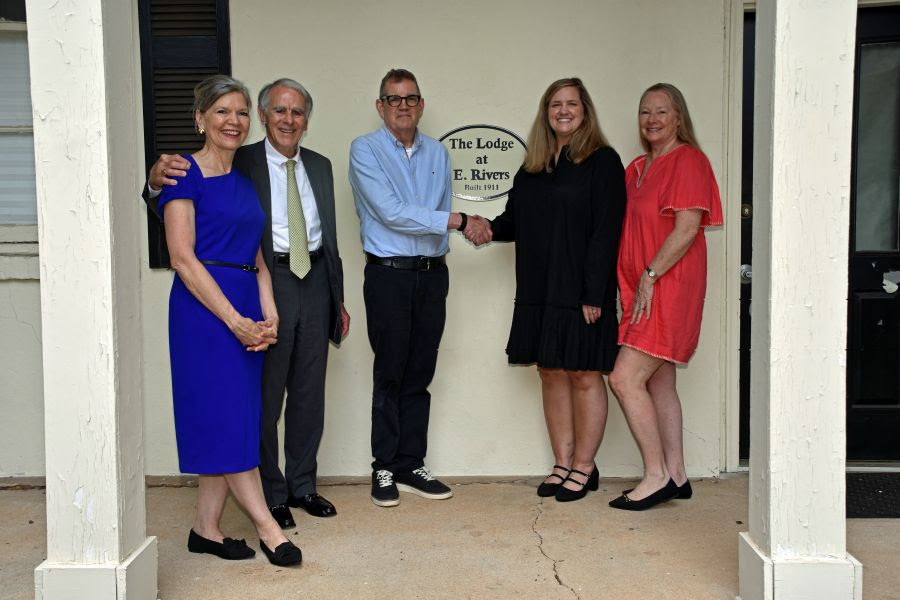
For Buckhead Heritage, the preservation nonprofit now celebrating its 20th year, saving the Lodge is both a milestone and a mission statement. Board secretary Frank Virgin framed it as a beginning rather than an end: Buckhead Heritage will “open this building up for the community, preserve and improve it, and create a space for residents and visitors to learn Buckhead’s history.” He called it “exactly the kind of project Buckhead Heritage was created to champion … a resource for the entire community,” and — invoking the milestone year — “a catalyst for broader engagement, preservation, and growth for the next 20 years and beyond.” Buckhead Heritage invites residents and businesses to help fund the restoration through memberships, sponsorships, and tax-deductible gifts; details are available at buckheadheritage.com.
There is a quiet comfort in familiar things — the landmarks that are reliably there. The little white house has been many things, but its steadiest gift has always been the same: it stays. In a part of town that never stops remaking itself, it remains the constant on the corner — and that is the comfort it gives Buckhead.