
A Tuxedo Park estate at 375 Blackland Road has sold for $18.6 million, making it the second-largest residential sale in Atlanta’s recorded history. Ben Hirsh of Hirsh Real Estate – Buckhead.com represented both the buyer and the seller in the transaction, which closed September 3. Buyer and seller both declined to be named.
Only one Atlanta home has sold for more. That was 3391 Tuxedo Road, at $19.8 million in March 2024, in an off-market all-cash deal that Hirsh also brokered. The two sales help make up a career total that will soon surpass $1.4 billion in homes sold.
The home was never publicly listed. It was offered exclusively through Buckhead.com, with its address and price withheld behind a password-protected page shared only with qualified buyers. There was no sign in the yard and no listing on the MLS.
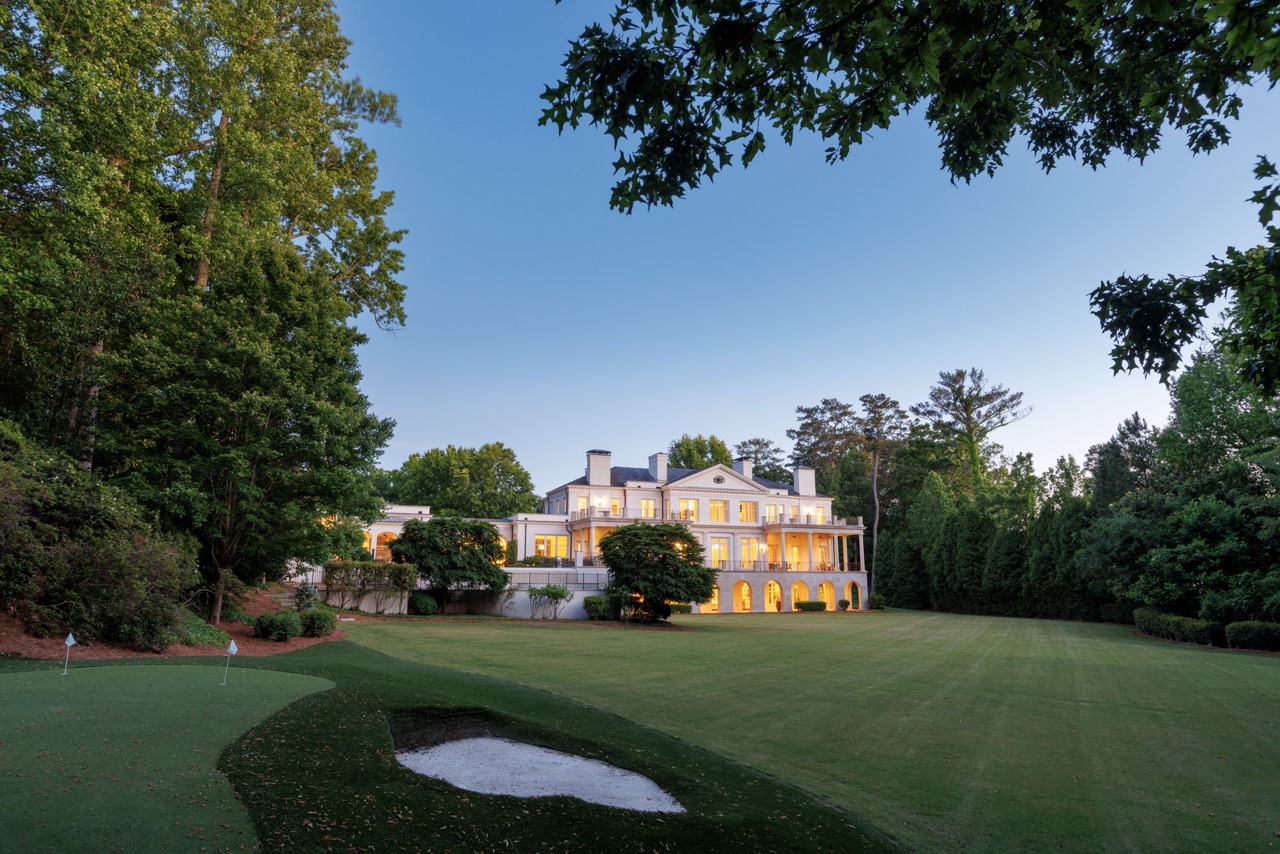
Blackland Road sits on 5.7 acres of level hilltop land in Buckhead’s Tuxedo Park neighborhood. Level acreage at this scale has become extremely rare in the area.
The home is a classic Georgian designed by Bill Harrison and built by Stan Benecki, Ken Dooley, and Shaba Derazi over three years. While these three worked together at the time, they have each gone on to operate independently and remain some of the most highly regarded luxury home builders in Atlanta.
Outside, there is a Jack Nicklaus-designed par-3 hole and a lighted full-size tennis court laid out along the ridge. Inside, an 1,800-bottle wine cellar, an English pub, a 15-seat theater, and a spa and fitness center. The property has dual gated entries, full perimeter fencing, a 150-kilowatt commercial generator, and a carriage house apartment.
“The owner built it to one of the highest standards I’ve seen,” Hirsh said. “It would be extremely hard and unfathomably expensive to recreate this today, and that’s where a lot of the value in it is found. And then there’s the land. You don’t find nearly six flat acres on a hilltop in Tuxedo Park anymore. That simply isn’t available.”
At $18.6 million, the sale works out to about $1,030 per square foot.
Hirsh represented the seller, offering the home privately to qualified buyers, and ultimately represented the buyer as well.
“I really enjoy putting buyers and sellers together into a win-win situation like this,” he said. “That is my favorite part of the job: I get to work with some of the most interesting people on the most beautiful homes anywhere in the country.”
Not every seller at this level wants a public campaign, he said. Some do, and a broad launch has real advantages. Others would rather he go find the right buyer quietly, with little or no publicity. “There are pros and cons to each. The private route is a lot more work, because I am doing the outreach myself instead of relying on marketing alone,” Hirsh said. “But when a seller asks for that, it’s my job to make it happen.” “Buckhead.com and The Buckhead Paper were critical conduits for this sale. So were relationships I’ve built over twenty-plus years of selling homes here,” Hirsh said. “The Paper reaches every mailbox in Buckhead, and the website reaches people well beyond it, including buyers overseas. One led to the other, and that led to a closing.”
Readers of The Buckhead Paper get the latest restaurant openings, Beltline updates, and other local news, along with exclusive access to real estate inventory in their own neighborhood. Hirsh sums up his dual role as broker and publisher in a single motto: “Bringing Buckhead closer together with every story we tell and every home we sell.”
The sale caps a lumpy year at the top of the Buckhead market.
Buckhead.com’s first-half 2026 market report found that the six months ending June 30 passed without a single home sale above $10 million, the first half-year without one since late 2023. The largest sale of the period was 1165 Garmon Road at $9.75 million. The money had shifted down a tier instead of leaving: the $5 million to $10 million band posted 18 sales, a very strong showing.
That report called the gap a pause rather than a retreat, and predicted it would break soon.
It broke in July, when Hirsh closed 3603 Knollwood Drive at $13.8 million. The 16,225-square-foot Siegel Construction estate sits on 1.58 hilltop acres in Tuxedo Park, and at the time it was 42% higher than any other sale in the Atlanta region this year. The lot underneath it had sold for about $2.6 million in 2024. Six weeks later, Blackland Road passed it by nearly $5 million.
Underneath those headlines, the market has been steadier than the trophy drought suggested. Buckhead’s single-family segment produced $1.02 billion across 541 sales in the first half, up 5.2 % year over year. Demand above $3 million actually strengthened, with 10 single-family contracts written in June against four in June 2025, even as supply in that tier climbed to 11.4 months.
The report’s other finding was that a growing share of the market never becomes public at all. Market research conducted by Hirsh Real Estate – Buckhead.com found that in the Buckhead area, there were 224 sales in the first half, roughly $298 million in volume, that never appeared on the MLS. That is about one home in five. Among the 10 largest sales of the half, four were private.
Blackland Road is now the largest of them.
Buyers at the top of the Buckhead market could easily choose to live anywhere in the world. Hirsh said the reasons they land here have less to do with money than outsiders expect.
“People assume it’s about price per square foot. It isn’t, or at least it isn’t first,” he said. “Quality of life is first. Buckhead is not beachfront. We don’t have the mountain views of Cape Town or the climate of Monterey. What we have is a place where you can raise a family well. We have the best private schools anywhere in the country, and I don’t think that’s a stretch. We have four real seasons and a tree canopy that makes half these neighborhoods feel like the country. You’re twenty-five minutes from the most-connected airport in the world, so you can still run a business somewhere else.”
What tips the decision, he said, is usually something about where they are coming from. “I hear the same things over and over from people who could live anywhere in the world. The excess in Palm Beach. The taxes in California. The politics in Seattle. The pace and the weather in Boston and New York,” Hirsh said. “At some point they ask themselves what they’re actually getting for all that, and Buckhead starts to look very good. You can have a beautiful home and a beautiful life here at the same time.”
Hirsh grew up in the northern suburbs of Atlanta and came to Buckhead in 2009 with no connections there.
“Everybody knew everybody, and the top agents knew everybody, and I knew nobody,” he said of those early years. He chose the neighborhood anyway, on the grounds that it was where he wanted to live and raise a family, and where the homes were the kind he could enjoy building a career around.
The turning point was a listing he lost. A high-profile listing for a prominent local real estate developer’s home went to an agent he considered less capable but far better connected socially. “You are just not Buckhead enough,” the seller told him. Discouraging as that was, it was also motivating. “I realized I needed to compete not on the social level, but with a level of marketing and branding that the competition wouldn’t be able to replicate and that sophisticated sellers would appreciate.” Then he had a thought: “I need to get Buckhead.com.”
The domain belonged to developer Ben Carter, who had intended it for the Streets of Buckhead project before the Great Recession reset the project (now Buckhead Village District and owned by Jamestown). Hirsh had approached him before without success. He went back, remade his last offer, and this time Carter agreed.
What he built on it was not a real estate website. Buckhead.com became a community publication covering the neighborhoods, schools, parks, businesses, and people of Buckhead, produced by a team of writers and photographers. In 2022, Hirsh extended it into print with The Buckhead Paper, which is now delivered quarterly to over 49,000 homes and businesses in the community.
“I couldn’t out-connect anybody when I got here, so I decided to add value instead,” he said. “All these years later, I know this community almost as well as anyone, because I’ve spent more than a decade writing about it. That turns out to be worth more than the connections I didn’t have.”