
In the summer of 2008, after another Neighborhood Planning Unit (NPU) meeting, three Buckhead neighbors sat down to talk through their frustrations. Jim King, Allison Adair, and Kim Jensen kept hitting the same walls — on transportation, city services, infrastructure, schools, taxes, and even the water. The problems piled up. But the deeper frustration was quieter and harder to fix: their neighborhoods, they felt, had no real voice at City Hall.
The NPU and the Buckhead Coalition both had direct lines to Atlanta’s leaders. Buckhead’s neighborhoods, the three agreed, were missing an advocate of their own.
So they set out to build one. Joining forces with Garth Peters, Gordon Certain, and Yolanda Adrian, they founded the Buckhead Council of Neighborhoods — an organization meant to carry the neighborhoods’ concerns straight to Atlanta’s leaders.
What started as a handful of frustrated residents grew, through steady recruiting, into a coalition of 45 associations, including the Buckhead Condo Alliance, with King as its first chairman. Roundtable discussions followed, and as the group’s reach widened, more and more of Atlanta’s officials began showing up to listen.
Nearly two decades on, the Buckhead Council of Neighborhoods does something its neighborhoods can’t easily do alone: it gives them a place to compare notes, pool hard-won experience, and speak to the city with one voice. Its leaders have built working relationships with some of Atlanta’s most prominent officials, and its meetings give city leaders a regular forum to hear residents out and engage directly.
It also offers something the city government rarely can — continuity. Administrations turn over; the council’s institutional memory does not, which lets it pursue solutions that outlast any single mayor or council term.
“It’s an important space to bring neighborhoods together and create that sense of broader community, so you can learn from one another,” says Emily Boatright, the council’s current chair. “If there’s an issue hitting your neighborhood, you have this great think tank that’s probably experiencing some of the same problems, and maybe they’ve got a better mousetrap to solve it. It’s also about not trying to engage either the city or other organizations alone.”
Debra Wathen, who joined the Buckhead Council of Neighborhoods first as president of the Paces neighborhood and eventually as chairwoman, weighed in on the importance of this collaboration. “There are that many neighborhoods and that little triangle. They’re all unique, and that’s the most important thing. What’s good for one is not necessarily good for another. So, it’s important that we all work together,” she said.
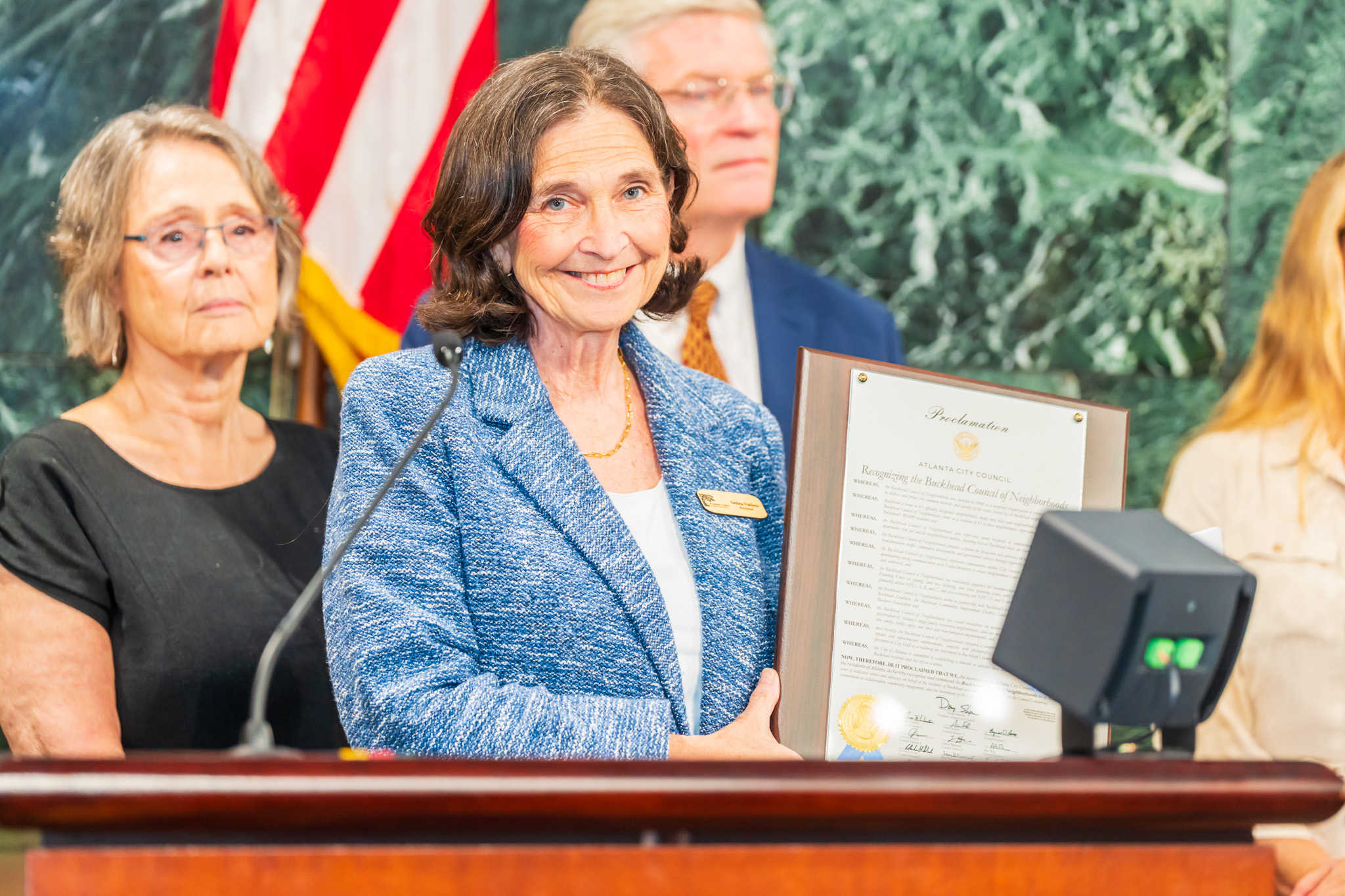
There are two issues, according to Boatright, that are consistently addressed by the Buckhead Council of Neighborhoods.
The first is zoning, particularly the importance of single-family zoning and the protection of the tree canopy encompassing most of Buckhead. Discussion of the city’s Tree Ordinance and the “lumping together” of single-family homes and commercial developments is often an agenda item.
The second pressing issue is improving and maintaining Buckhead’s infrastructure, maintenance of the roads, crime and safety, flood prevention, and, most recently, traffic. “It’s an issue that arises when living in the city, as people have more navigation in their cars. We’ve started to see that everyone wants to take the quickest route, and those navigation systems often reroute a lot of commuter traffic through neighborhoods,” says Boatright.
Because the neighborhoods represented by the BCN constitute a massive engine of Atlanta’s property tax revenue, the council’s meetings function as a crucial proving ground for citywide financial legislation. That dynamic was on stark display at a recent meeting, where the primary focus was the Neighborhood Reinvestment Act and Tax Allocation Districts
What began as an organization for being heard has become the place where city legislation gets tested against the neighborhoods it will touch. Whatever lands on the agenda next, the Buckhead Council of Neighbors’ role is the same one it was built for in 2008: making sure Buckhead’s neighborhoods are in the room and heard, before the decisions get made.